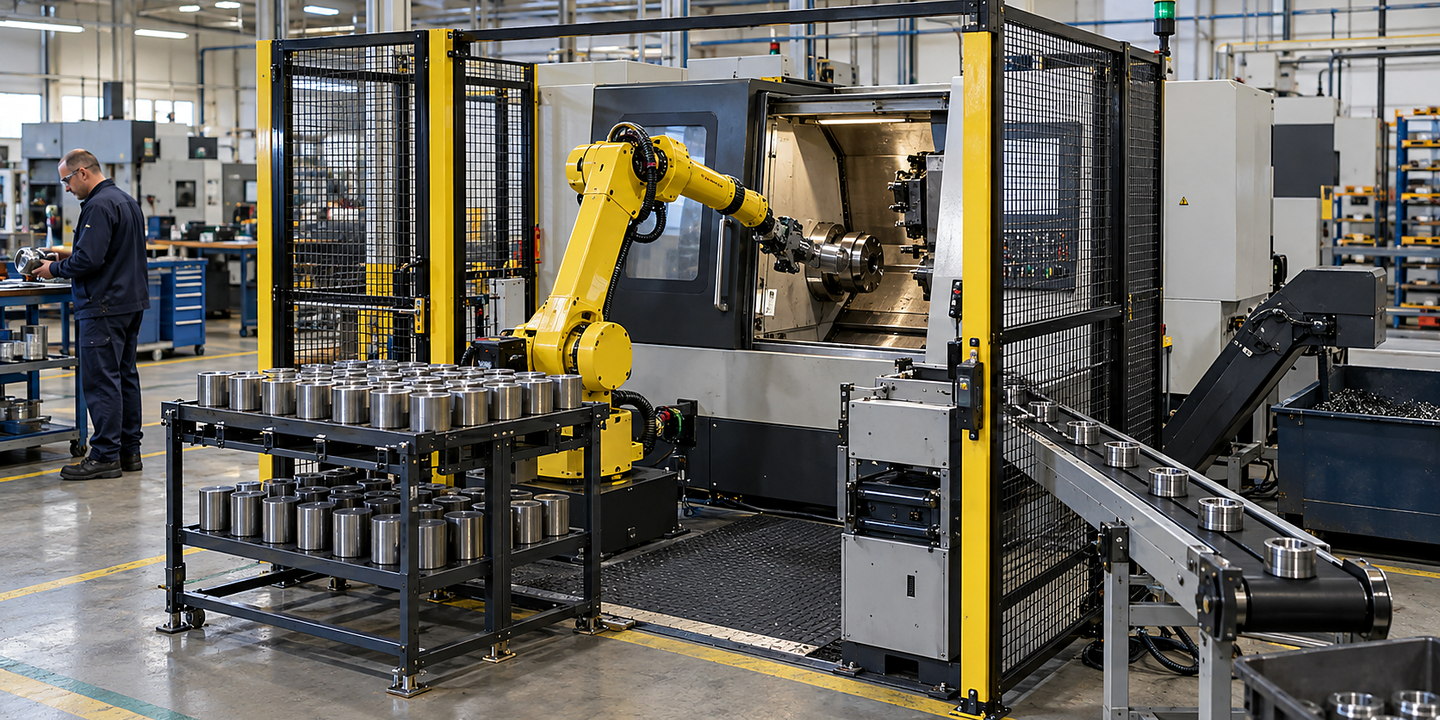
Plan mechanical, electrical, control, data, safety and operator interfaces for robotic test automation.
In brief
Define the handover between robot, test fixture and test controls. Agree loading signals, result association, unloading, operator recovery and the response to an incomplete test or missing result.
Allocate each fixture, tester and cell interface to an owner, including identity, recipe requests, acknowledgements, timeouts and result storage. Carry unresolved responsibilities into the acceptance plan before installation.
On the production floor
Connect equipment, controls and people into one reliable process — Robotic Test Automation
Plan robotic test automation around your parts, process, cycle time, tooling, recovery and acceptance criteria. Discuss the highest-risk feasibility questions with Oxford Industrial Automation. Your integration review should connect required cycle and production pattern, tooling, sensing and process interfaces and the people who run the process.
Six areas to coordinate for robotic test automation
Mechanical
Confirm fixture datums, seating, connection and disconnection requirements, loads, access and transfers. Include the connectors, probes, seals or other interfaces needed by the test; robot position alone does not confirm the required loaded condition.
Electrical
For Robotic Test Automation, list the supplies, isolation, protective devices, panels and cable routes required by the proposed installation.
Controls
Agree ready, loaded, start, busy, complete, fault and result states as required by the tester, with acknowledgements and timeouts. Define recipe selection and the response to a failed test separately from a missing or incomplete result.
Safety
Review risk controls, stop behaviour, access, reset and the checks needed around tooling, sensing and process interfaces.
Data
Keep the component identifier, fixture or nest, test request, recipe and result associated until disposition is complete. Define timestamps, retention and storage-recovery needs, including how delayed messages and authorised retests remain tied to the correct component.
Your team
Allocate normal operation, replenishment, cleaning, maintenance and changeover duties. Agree who may authorise a retest, how the original result is retained, and how parts left in fixtures or awaiting results are reviewed before work resumes.
How the work comes together
Plan fault recovery for repeatable production using robotic loading of functional tests as carefully as normal running
For Robotic Test Automation, your team can review each stage before the complete installation is put into routine use.
01
Observe the Current Process and Collect Representative Samples
Share representative parts, process observations and cycle data, including the normal range for part, product and process variation for robotic loading of functional tests and the difficult arrival pattern and presentation cases.
02
Prove Handling and Process Risks in a Focused Feasibility Trial
Compare suitable methods and use focused trials to show how each option performs against required cycle and production pattern.
03
Design and Build the Complete Guarded Cell
Connect the equipment to your line, services and controls while resolving tooling, sensing and process interfaces for day-to-day operation.
04
Run Agreed Scenarios and Support Production Ramp-Up
Confirm operator access, recovery and changeover, then complete and record run-off criteria and production evidence before your operating team takes over.
For your application: check required cycle and production pattern, tooling, sensing and process interfaces, operator access, recovery and changeover, and run-off criteria and production evidence as part of the complete line trial.
Important limits
Line connections can change the approach for Robotic Test Automation
Cycle time depends on the complete process rather than robot speed alone.
Part presentation, tolerances and recovery cases must be included in feasibility work.
Collaborative operation or automatic handling cannot be assumed safe without an application assessment.